

ALL HALLOWS, ROMAN TILES AND NUNS WHO STITCHED HISTORY

1066: THE TAPESTRY OF A CONQUEST (PART 1)
How London's oldest church connects to William the Conqueror, and the Bayeux Tapestry
When we think of 1066 and the Norman Conquest, we usually picture the muddy battlefield in East Sussex or the giant stone walls of the Tower of London. But did you know that right in the heart of London, there’s a quiet, beautiful church that saw 1066 happen in real time?
All Hallows by the Tower—historically known as All Hallows Barking or Berkyngechirche—didn't play a direct role in the fighting or the political battles. But it holds a mind-blowing connection to the story. Every time I walk through those doors, I get so excited knowing I'm standing somewhere that whispers secrets from nearly 1,000 years ago!
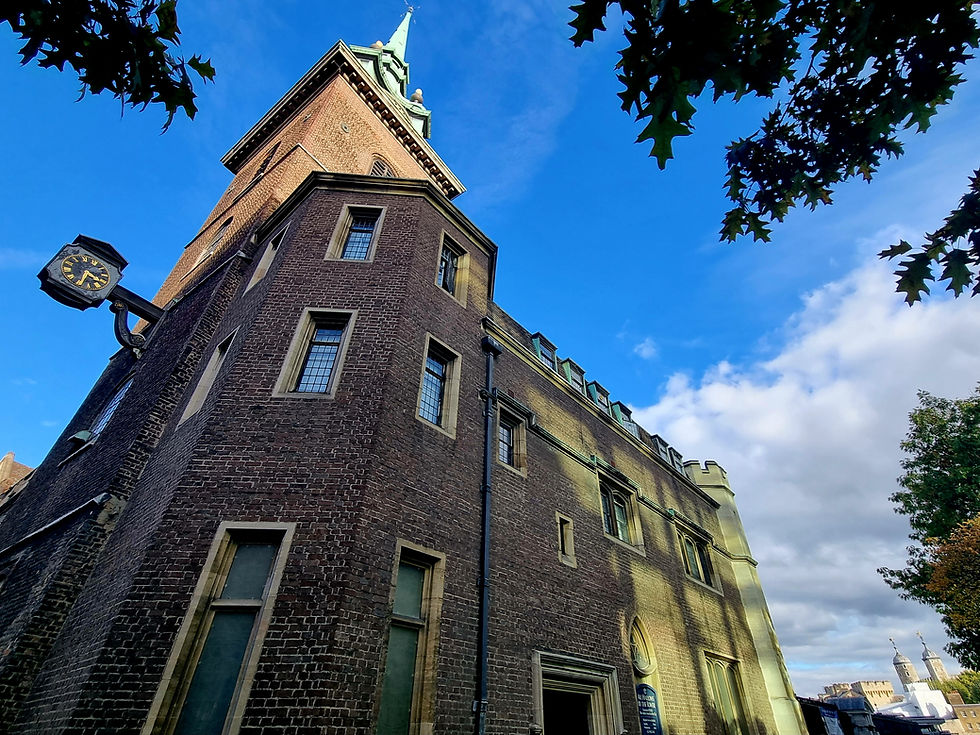
Surviving the Centuries: The Saxon Arch
When you step inside All Hallows, you are stepping straight into London’s oldest church. It was founded all the way back in 675 AD by Erkenwald, the Bishop of London, as a chapel and property for the great Barking Abbey (where his sister Ethelburga was the abbess!). That means this sacred site is roughly 300 years older than the Tower of London next door!
What makes this place extra special for history lovers is what survived World War II. When bombs damaged the church during the Blitz, workers and archaeologists started exploring deep underneath. And guess what they found? A real, surviving 7th-century Saxon arch! It's actually the oldest surviving architectural piece in the whole City of London.
When you head down into the crypt and stand right next to that arch, if you look closely, you’ll see it was built using recycled Roman tiles! Standing there always gives me absolute goosebumps as I realize I am looking at the exact architecture that Londoners walked past decades before William ever set foot on English soil. It’s a literal, touchable bridge between Roman London and the Anglo-Saxon world!

The Nuns of Barking and the Masterpiece
So, how does a London church linked to Barking connect to a world-famous masterpiece like the Bayeux Tapestry?
This is where my imagination goes completely wild!
It all comes back to Barking Abbey. In Anglo-Saxon times, this wealthy nunnery was famous across Europe for being a powerhouse of literacy and producing Opus Anglicanum (which literally means "English Work"). It was a celebrated style of luxury embroidery known for its intricate use of gold, silver, and fine wool thread on linen.
Nobody knows where the Bayeux Tapestry was actually stitched. But here is my absolute favourite theory: given how world-famous these English nuns were for their needlework, many historians believe it wasn't made in France at all! It might have been designed and stitched right here in England by the talented, highly skilled nuns of Barking Abbey!
Because All Hallows Barking was directly owned by Barking Abbey in the 11th century, it ties the church, the abbey, and the tapestry together. When you stand under the Saxon arch at All Hallows today, you are just a short distance from where those weavers might have sat nearly 1,000 years ago, stitching the dramatic story of the Norman Conquest into linen. It brings the history of 1066 so much closer to home!
William’s Royal Footprint
The story gets even better! Right after his victory at Hastings, William the Conqueror needed a safe and prestigious place to stay close to the capital, while the stone Tower of London was being planned down by the river.
Instead of taking total control by force, William and the leaders of London made a delicate political deal. To make it official, William issued a tiny, precious piece of parchment written in Old English: the famous 1067 William I Charter. It promised Londoners that he would respect their existing rights and laws. (You can still see this incredible document preserved in the City of London archives today!)
And while all of this was happening, where did William set up his base? Barking Abbey!
The Conqueror literally lived at the abbey while preparing to build his new royal stronghold just down the street. Right here, Saxon leaders like Edgar Ætheling, Morcar of Northumbria, and Edwin of Mercia officially surrendered to William.
Standing near All Hallows today and looking out toward the Thames and the Tower, you can almost map out William's exact footsteps as he took control of England.

Looking Ahead
All Hallows by the Tower doesn't start the story of 1066, but it connects everything so beautifully — the ancient Saxon arch built from recycled Roman tiles, the brilliant needlework reputation of Barking's nuns, and the footprint of a Norman duke taking power.
To see how William actually won his crown, though, we have to leave the quiet stone church of London behind and head south.
Next stop: A bright, sunny autumn day in East Sussex, the smell of woodsmoke, and a weekend of living history on the battlefield!
Plan your visit: All Hallows by the Tower
Location: Byward Street, London EC3N 5BJ (just a short walk from Tower Hill Underground Station and the Tower of London).
Opening Hours: Monday to Friday 8:00 AM – 5:00 PM; Saturday and Sunday 10:00 AM – 5:00 PM. Entry to the church and crypt museum is free (donations welcome).
What to see: Follow the sign to the crypt museum to view the 7th-century Saxon arch and the remains of a 2nd-century Roman floor preserved beneath the altar.
Question to you: Have you ever visited a spot in London where ancient history suddenly felt completely real to you? Let me know in the comments!


Comments